Joseph Barratt was born to
single parent Emma Barratt.
.
He
was
born
at
Edgmond
near
to
Newport,
Shrop
shire
on
23
rd
May
1897
and
grew
up
at
Outwoods in the home of his
grandparents Ri
chard and Mary
Barratt.
He
attended
the
village
school
at
Moreton
until
he
was
14
years
old,
and
worked
as
a
brickl
aye
r’s labourer
.
The
coming
o
f
war
i
n
Augu
st
1914
changed
everything
there
was
a
great
need
for
young
m
en
t
o
join
the
colours
to
fight
.
H
e
enlisted
i
n
Newport
Shropshire
o
n
9
t
h
Decem
ber
.1915,
aged
18
.
Following
a
period
of
training
he
was
posted
t
o
the
4
th
Battalion
North
Staffordshire
Reg
iment.
The
4
th
North
Staf
fs
although
raised
in
1914
did
not
g
o
to
France
until
October
1917,
bu
t
from
then
on
,
the
battalion
was
involved
in
very
serious
fighti
ng,
part
icularly
i
n
March
1918
when
they
helped
to
hold
the
line
against
a
massive
Ger
man
onslaught
and
aga
i
n
in
Sep
tember
.
On
29
th
September
1918
i
n
heavy
fighting
near
the
village
o
f
Z
andvoord
e
in
Belgi
um,
a
n
attack
o
n
the
Germans
was
a
success,
though
during
this
one
da
y
o
f
fighting,
al
most
20
0
soldiers
o
f the 4
th
North Staffs were killed, including the
21
years old Joseph Barratt.
Private
Joseph
Barratt
is
buried
close
to
where
he
fell
in
what
is
now
Zandvoorde
British
Cem
etery
.
Joseph Bar
ratt
Private 25206
– 4
th
Battalion, North Staffor
dshi
re Regi
men
t
Ki
lled in
Ac
tion 29
th
September
19
18
Buri
ed in Zandv
o
orde Briti
s
h Cem
etery
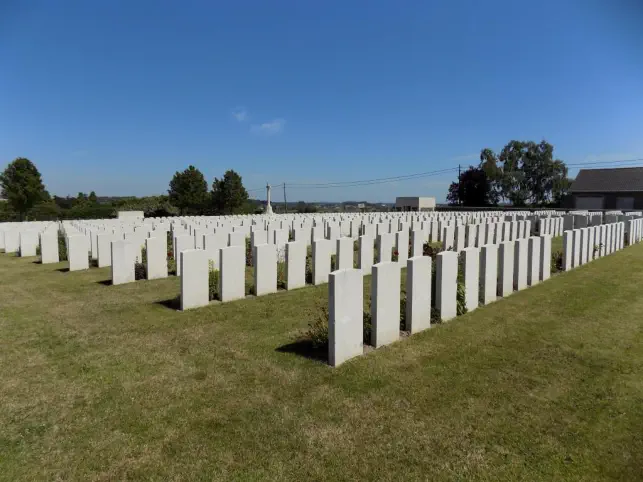
Zantvoorde British Cemet
ery
Historical Informatio
n
On 30 October
1914, the village of Z
antvoorde (now Zandvoorde) w
as hel
d by the 1st and
2nd Life
Guards
, numbering between 300 and 400 men. It was
bombarded
for ov
er an
hour with heavy guns
and
then taken
by the
39th Ger
man Division
and
three attached
battalions. The whole front of the 3rd Cavalry Division was driven back to the Klein
-
Zillebeke ridge. The village could not
be retak
en and remai
ned in German
hands until 28
September 1918. The Household Cavalry Memorial, unveiled by Lor
d Haig in
May 1924,
stands
on the So
uth side of the village
at the
place where part of
the Brigade was
annihilated in 1914
.
Zantvoorde British Cemetery was made after the
Armistice when remains were brought in
from the bat
tlefields and nearby G
erman cemeteries. Many were those of s
oldiers who
died in the desperate fighting round Zantvoorde, Zillebeke and Gheluvelt in the latter
part
of October
191
4.
There are now 1,583 servicemen of the First World W
ar buried or commemorated in the
cemetery
. 1,135 of the burials are unidentified. Special memorials commemorate 32
soldiers buried in tw
o of the Ger
man cemeteries whos
e graves could not be found on
concentration. The cemetery also contains one Second W
orld W
ar burial.