
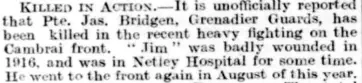
James George Bridgen was born on the 12th January 1895 in Huddlesford, Staf
fs and
was baptised on the 14th of February 1
895 at St Giles
Church, Whit
tington. His parents
were William Bridgen (a bricklayer’s labourer, later a roadman)
and Emma Elizabeth Swift.
They had six children, five of w
hich survived. James attended the village school in
W
hittington.
On the 191
1 Census, he was 16 and working as a farm labourer
. Later that year it is
thought that he m
oved to Gnosall and worked as a trainee butcher
.
He joined the 3
rd
Grenadier Guards, and badl
y wounded in 1916 spendin
g some time in
Netley Military Hospital near Southampton
.
He was
sent back to the Front in
August 1917.
He was killed in action
at the
Battle of Ca
mbrai on
27
November 1917.
James has no known grave but is remember
ed on the Cambrai Memorial, Louverval
(panel 2), France and on the St Giles Organ, Whittington, nr
. Lichfield.
His name is
misspelt on
the Com
monwealth War Grave
s website
as “Ja
m
es Geo
rge B
rigden”
James G Bridg
en
Priv
ate 18621 -
3
rd Grenadi
e
r Gu
ards
Ki
lled in
Ac
tion 27
th
Nov
em
ber 1
9
17
– aged 22
Remem
ber
ed on
the Camb
rai M
e
mori
al
, Louv
erval
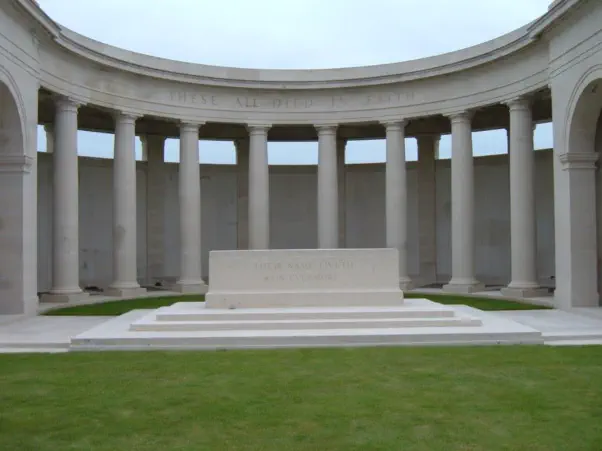
Cam
brai Memorial, Louverval, France
Historical Informatio
n
The CAMBRAI MEMORIAL
commemorates more than 7,000 servicemen of the United
Kingdom and South
Africa who died in the Battle of Cambrai in November and December
1917 and whose
graves are not known.
Sir Douglas Hai
g described the object of the Cambrai
oper
ations
as
the
gaining of a 'l
ocal
success by a sudden attack at a point where
the enemy di
d not ex
pect it' and to some
extent they succeeded. The proposed method of assault was new
, with no prelimina
ry
artillery bombardment. Instead, tanks would be used to
break through the German wire,
with the infantry followi
ng under
the cover
of smoke barrages.
The attack began early in the morning of 20 November
1917 and initi
al adv
ances w
ere
remarkable. However
, by 22 November
, a halt was called for rest and reorganisation,
allowing the Germans to reinforce. From 23 to 28 November
, the fighting was
concentrated almost entirely around Bourlon Wood and by 29 November
, it was clear that
the Germans were ready for a major counter attack. During the fierce fighting of the
next
five days
, much of the ground gained in the initial days of the attack
was lost.
For the
Allies, the results of the battle were ultimately disappointing but valuable lessons
were learnt about new strategies and tactical
approaches
to fighti
ng. The Germans had
also discovered that their fixed lines of defence, no matter how well prepare
d, were
vulne
rable.