
George
Henry
James
Debney
was
the
oldest
o
f
the
five
children
born
t
o
Sarah
and
George
Deb
ney
.
Ge
orge
was
born
in
1892
in
th
e
villag
e
o
f
Moreton
where
h
is
fa
ther
was
th
e
blacksm
ith.
T
wo
o
f his siblings sadly died in infancy
.
George
woul
d
have
been
educ
ated
at
t
he
village
sc
hool
and
le
aving
school
aged
14
in
190
6
he found work as a gardener
.
The
coming
o
f
war
in
A
ugu
st
1914
saw
the
need
for
volunteers
to
join
the
army
and
it
seems
that
Georg
e
Debney
was
on
e
that
v
olunt
eered
early
i
n
the
war
when
h
e
was
enlisted
a
t
Shrewsbury
into
a
local
regiment,
the
King’s
Shropshire
Light
Infantry.
Following
training
h
e
was
posted
t
o
the
5
th
battalion
and
went
to
France
with
them
landing
i
n
Bou
logne
o
n
22
n
d
May 1915.
George
Debney’
s war would be
a sho
rt o
ne.
The
5
th
Battalion
King’s
Shropshire
Light
Infantry
was
in
the
42
nd
Brigade,
14
th
Light
Infantry
Division.
This
division
saw
action
a
t
Hooge
o
n
30
th
–
31
st
July
1915
when
the
Germans
first used flame throwers.
They next saw action at the Battle of Loos f
ought between 25
t
h
Septem
ber and 15
th
October 1915.
This was the first genuinely large scale British offensive action, but in a
supporting role to a larger French attack in the Third Battle of
Artois.
The battle is
historically noteworthy for the first British use of poison
gas
Compared
with
the
small-scale
British
ef
forts
o
f
spring
1915,
this
attack
o
f
six
Divisions
(60,000)
men
was
a
mighty
offensive
and
at
the
time
was
referred
t
o
a
s
‘The
Big
Push’.
Despite
heavy
casualties,
there
was
considerable
success
o
n
the
first
day
in
breaking
into
enemy positions
near
Loo
s
an
d Hulluch.
Private
George
Debney
was
one of
the
casualties
on
this
first
day
, he
has no
known
grave
and is remembered on the Menin Gate at Y
pres in
Belgium.
George H.J. Debney
Private 1501
1
–
5
th
B
attali
o
n
Kin
g’
s
Shrops
hire
Light
I
n
fa
ntry Ki
lled in ac
ti
on 25
th
September
19
15
– aged 23
Remem
ber
ed on
the Me
ni
n G
ate
at
Y
p
res in Be
l
gi
um
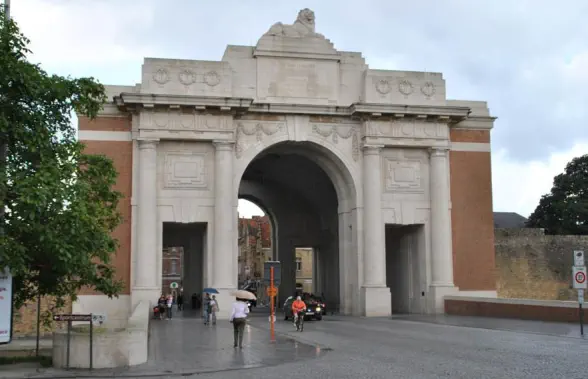
Y
pres (Menin Gate) Mem
orial
Historical Informatio
n
Y
pres (now Ieper) is a town in the Province of W
est Flanders. The Memorial is situated at
the eastern side of the town on the road to Menin (Menen) and Court
rai (Kortrijk).
Each night at 8 pm the traf
fic is stopped at the Menin Gate while members of the local Fire
Brigade sound the
Las
t Post
in the roadway under t
he Me
morial's
arches.
The Meni
n Gate is one of four memorials to the missing in Belgian Flanders which cover
the area known as the Y
pres Salient. Broadly speaking, the Salient stretched from
Langemarck in the nort
h to the nort
hern edge in Ploegsteert Wood in the sout
h, but it
varied in area and shape throughout the war
.
The Salient was formed during the First Battle of Y
pres in October and November 1914,
when a small British Expeditionary Force suc
ceeded in s
ecuring the town bef
ore the onset
of winter
, pushing the German forces back to the Passchendaele Ridge. The Second
Battle of Y
pres began in
April 1915 when the Germans released poison gas into the
Allied
lines north of Y
pres. This was the first time gas had been used by either side and the
violence of the attack forced an
Allied withdrawal and a shortening of the line
of defence.
The site of the M
enin Gate w
as chosen bec
ause of the hundr
eds of thous
ands
of
men who
passed thro
ugh it on their way to the battlefiel
ds. It commemorates
casualties
from the
forces of
Australia, Canada, India, South
Africa and United Kingdom who died in th
e
Salient. In the case of United Kingdom casualties, only those prior 16
August 1917 (with
some exceptions). United Kingdom and New Zealand servicemen who di
ed after t
hat date
are named on the memorial at
T
yne Cot, a site which marks the furthest point rea
ched by
Commonwealth forces in Belgium until nearly the end of the war
. New Zealand casualties
that died prior to 16
August 1917 are commemorated on memorials at Buttes New British
Cemetery and Messines Ridge British Cemetery
.