
The
sec
ond
of
J
osiah
and
Mary
Fereday’s
three
children,
all
boys,
Frank
John
Fereday
was
born
i
n
1891
in
Smethwick,
Staffordshire
which,
confusingly
,
a
t
the
time
was
i
n
th
e
registration district
of King’s Norton,
Worcestershire.
The
1901
and
the
191
1
census
show
that
for
a
t
least
1
0
years
the
family
lived
a
t
30
,
S
t
Mary’s
Road
in
Be
arwood
an
area
o
f
Sm
ethwick.
Frank’
s
f
a
t
her
Josia
h
was
a
secon
d
-
generation
master
builder
who
had
m
arried
farmer’s
daughter,
Mary
Titley
of
Moreton
i
n
1886
.
Having
completed
his
education
Frank
went
t
o
work
in
his
father’s
building
business.
In
the
summer
o
f
1914
h
e
married
Nora
Garb
ett
i
n
Smethwick
bu
t
they
may
have
moved
t
o
Bromst
ead
shortly
after
a
s
t
heir
two
daughters;
Dorothy
Annie
(1
915)
an
d
Nora
Hel
en
(1
916)
were both born in M
oreton .
With
the
coming
o
f
war
i
n
August
1914
and
the
devastating
losses
that
followed
there
was
a
great
call
for
men
to
volunteer
for
military
service
and
then
in
J
anuary
1916
conscripti
on
was
introduced.
Whether
Frank
was
a
volunteer
o
r
a
conscript
is
unknown
.
His
medal
entitlement indicates that
h
e was
i
n action after 1
st
January 1916.
On
21
st
March
1918
the
Germans
launched
the
first
phase
o
f
a
major
of
fensive
called
‘Operation
Mich
ael
’.
The
attack
targeted
British
and
Co
mmonwealth
forces
al
ong
t
he
Somme
and
aimed
to
break
thr
ough
their
lines
and
potentially
capture
key
transport
hub
s
like
Amiens
and
Ypres.
While
the
German
forces
achieved
significant
territorial
gains
in
the
initial
days,
they
were
ultimately
unable
t
o
achi
eve
their
strategic
objectives
and
th
e
offensive stalled, contributing
t
o the end
o
f the war
.
Frank
with
the
6
th
Battalion
o
f
the
Royal
W
arwickshire
Regiment
was
engaged
in
heavy
fighting
during
this
German
offensive,
defending
a
line
west
o
f
Saint-
Quentin.
The
Germans
began
with
a
m
assive
artillery
bom
bardm
ent,
followed
b
y
infantry
advances.
During
th
e
fighting
the
6
th
Royal
W
arwicks
suf
fered
significant
casualties,
with
men
killed,
wounded,
and
taken
prisoner
including
Frank
Fereday
who
a
t
the
end
o
f the
day
was
una
ccounted
for.
For
his
family
there
foll
owed
a
n
anxious
period
o
f
no
t
knowing
what
ha
d
happened
to
hi
m,
with
enquiries
being
made
o
f
the
Red
Cross
on
2
nd
August
and
again
o
n
20
th
November
1918
until
it
was
confirmed
that
he
had
in
f
act
died
o
n
2
1
s
t
March
19
18.
Frank
Fereday
ha
s
n
o
k
nown
grav
e
but
is
remembere
d
o
n
Panel
1
8
and
1
9
o
f
the
P
oz
ieres
Memorial
t
hou
gh
t
he
inscription
lists
his
name
a
s
“Frank
John
Fareday”.
He
is
also
included
on
th
e
plaque
a
t St
Mary’s Church, M
o
reto
n.
Frank J. Fereday
Priv
ate 241512
-
Battalion Roy
al
W
arwickshi
re
Regi
ment
Died on 21
st
Ma
r
c
h 1918
– aged
27
Remem
ber
ed on
the P
oz
i
eres M
e
mori
al
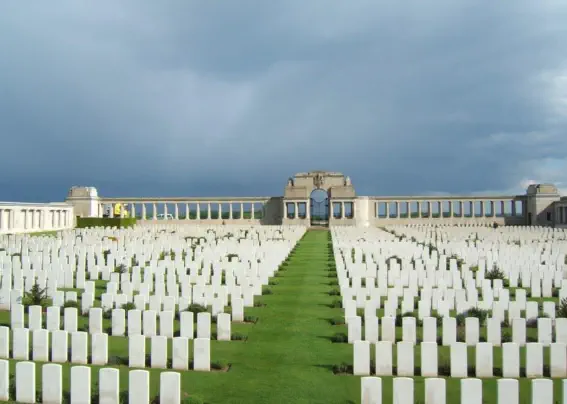
Pozieres Memorial, Somme,
Historical Informatio
n
The POZIERES MEMORIAL
relates to the period of crisis in March and
April 1918 when
the
Allied Fifth
Army was driven back by overwhelming numbers across the former Somme
battlefields, and the months that followed before the
Advance to Victory
, which began on 8
Augus
t 1918
.
The Memorial commemorates ov
er 14,000 casualties
of the United
Kingdom and 300
of
the South
African Forces who have no known grave and who died on the Somme from 21
March to 7
August 1918.
The Corps and Regiments most largely represented are The Rifle
Brigade with over 600 names, The Durham Li
ght Infantry with approximately 600 names,
the Machine Gun Corps with over 500, The Manchester Regiment wi
th approximately 500
and The Royal Horse and Royal Field
Artillery with over 400 names.