Henry was born Henry
Allsop. He was baptized at
The Parish Church of Saint Giles'
Haughton on the 18
th
October 1899 the son of a Single Woman, Emily
Allsop.
At the time
she was a servant at Shippey Farm, Haughton
.
Emily was herself born to a Single Woman Emma
Allsop in 18
85. Emma married Richard
Hill in Bradeley in
1887.
In 1891 Emily was living at Bradley
at her Grandmother
, Maria
Allsop
’s house. Also at the
ho
use
a
re Richard Hill and
his wife
Emma, Emi
ly’s moth
er.
In 1901 Henry is living with his Grandfather Richard James Hill at Chetwynd
Aston.
However
, in 1904, he appears on the school register at Moreton School as Henry Hill with
guardian named as Richard Hill. His date of birth is given as 21
st
September 1899.
Also
attending are two more of the family
.
Alice and Herbert John Hill (Although enrolling
together
,
Alice and Herbert a
re Henry’s
Aunt and Uncle).
In 191
1, aged 11, Henry is still living with the family at Summer Houses, Befcote.
There appears to be no more information for Henry despite consider
able research by
Gnosall Heritage members
.
We believe Henry signed up using his adopted name
Henry Hill with the South
Staf
fordshire Regiment with Service Number: 240706,1st/6th Bn., South Staffordshire
Reg
iment
. He
died on 1
st
July 1916.
Remembered with Honour
,
Thiepval Memorial, France, Pier and Face 7 B.
His army record has not survived. His medal
card shows
he arrived
in France
on
28th
June 1915, was awarded 1914/15 Star
, British W
ar and V
ictory Medals and was killed in
action on 1st J
uly 1916. It also recor
ded an earlier army number 3228.
Henry Hill
Pri
v
ate 240706
– 1
st
/6
th
South Staf
fordshi
re
Regi
me
nt
Ki
l
led in
Ac
tion 1
st
J
ul
y
1916
– aged17
Remember
ed wi
t
h Honou
r
,
T
hi
epv
al
Mem
orial
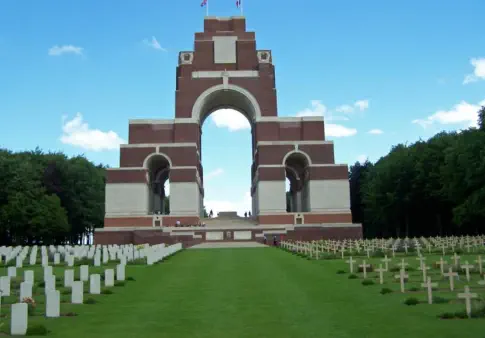
Thiep
val Me
mo
rial
History
informa
tion
On 1 July 1916, supported by a Frenc
h attack
to the sout
h, t
hirteen divisions of
Commonwealth forces launched an offensive on a line from north of Gommec
ourt to
Maricourt. Despite a preliminary bombardment lasting seven days, the Ger
man defences
were barely touched and the attack met unex
pectedly fierce resistance. Losses were
catastrophic and with only mini
mal advances on the southern fl
ank, the initial attack
was a
failure. In the following weeks, huge resources of manpower
and equipment w
ere
deployed in an attempt to exploit the modest successes of the first day
. However
, the
German
Army resisted tenaciously and repeated attacks and counter attacks meant a
major battle for every village, copse and farmhouse gained.
At the end of September
,
Thiepval was finally captured. The village had been an original objective of 1 July
.
Attacks
north and eas
t continued throughout October and into November in increasingly difficult
weather conditions. The Bat
tle of the Somme
finally ended on 18 November with the onset
of win
te
r
.
In the spring of 1917, the German forces fell back to their newly pre
pared
defenc
es, the
Hindenburg Line, and there were
no
furth
er significant engagements
in the Somme s
ector
until the Germans mounted their major of
fensive in March 1918.
The Thiepval Memorial
, the Memorial to the Missing of the Somme, bears the names of
more than 72,000 officers and men of the United Kingdom and South
African forces who
died in the Somme s
ec
tor bef
ore 20 March 1918 and
have no know
n grave. Over 90% of
those commemorated died between July and November 1916. The memorial als
o serves
as an
Anglo-French Battle Memorial in recognition of the joint nature of the 1916 offensive
and a small cemetery
contai
ning equal numbers of Commonw
ealth
and Fre
nch graves lies
at the foot of the
me
morial.
The
memorial, designed by Sir Edwin Lutyens
, was built between 1928 and
1932 and
unveiled by the Prince of W
ales, in the presence of the President of France, on 1
August
1932 (originally scheduled for 16 May but due to the death of Frenc
h Presid
ent Do
umer
the ceremony was postponed until
August).
The dead of other Commonwealth countries, who died on
the
Somme
and hav
e no know
n
graves, are commemorated on national
memorials elsewhere
.