George
Howells
the
eldest
o
f
six
childre
n
wa
s
born
i
n
1887
a
t
Bro
mstead
near
to
Gnosall;
the
son
o
f Thomas
a
farm
labourer
and
his
wife
Emma.
In
November
1905
the
18
years
old
George
attested
for
the
3
rd
V
olunteer
Battalion
North
Staf
fordshire
Regiment,
this
battalion
was
a
forerunner
o
f
the
T
erritorial
Army
that
was
introduced
1908.
A
t
the
time
o
f
his
enlistment
h
e
was
employed
a
s
a
groom
b
y
Dow
age
r
Lady
Salt
a
t
W
eep
ing
Cross,
Stafford.
The
191
1
census
records
that
George
is
employed
a
s
a
game
keeper
.
However
,
in
1912,
now
age
24
he
decided
on
a
career
change
and
enlisted
at
Shrewsbury
into
the
King’s
Shropshire
Light
Infantry.
After
trainin
g
a
t
the
depot,
h
e
was
posted
t
o
the
1
s
t
B
attalion
who
were based
a
t
T
ipperary
i
n Ireland.
At
t
he
outbreak
of
the
Grea
t
War
1914
the
1st
Ba
ttalion
King’
s
Shrop
shire
Light
In
fan
try
(1/
KLS
I)
was
part
o
f
16th
Infantry
Brig
ade
,
6th
Division.
The
battalion
was
quickly
mobilised
and
travelled
to
Fra
nce arriving
a
t the port
o
f
S
t Nazaire
on
10
th
September 1914.
V
ery
soon
after
arriving
in
France
1/KSLI
was
in
action
fighting
the
Germans
a
t
the
River
Aisne.
During
this
battle,
which
lasted
from
10
th
to
13
th
September
British
and
French
forces
attempted
to
capture
the
heights
o
f
the
Chemin
de
s
Dames
abo
ve
the
River
Aisne.
Th
e
attack
di
d
no
t
s
ee
the
Germans
removed
fro
m
the
heights
no
r
coul
d
the
Germans
dislodge
the
British,
what
did
happen
was
the
first
def
ensive
trenches
were
dug.
I
n
the
aftermath
o
f
the
battle
1/KLSI
held
and
defended
positions
on
the
Chemin
des
Dames
t
o
the
north
o
f
the
River
Aisne until 22
nd
Sep
tember 1914.
On
1
st
Oct
obe
r
the
battalion
took
over
trenches
half
a
mile
t
o
the
west
o
f
Vailly.
These
were
then
held
until
12
th
October
when
1/
KLS
I
was
replac
ed
b
y
French
tr
oop
s
.
This
first
dep
loyment
had
been
a
trench
holding
ope
ration,
the
type
o
f
deployment
that
would
featur
e
for much
o
f the war f
or
1
/ KLSI. In those few
weeks 1/KLSI lost 3 killed and
7 wounded.
Between
January
and
May
1915
1/KSLI
remained
i
n
the
Armentieres
sector
continuing
its
trench
holding
ope
rations.
During
these
five
months
o
f
relative
quiet
1/KSLI
suffered
3
1
killed
and
6
7
w
ounded
mainly
fro
m
artillery
and
s
niping
includi
ng
G
eorge
Howells
wh
o
is
recorded
a
s
killed
i
n
action
o
n
10
th
March
1915.
He
i
s
buried
i
n
Ration
Farm
Military
Cemetery
a
t
L
a Chapelle
– D’Arm
enti
eres.
George Howell
s
Private 9809
– 1
s
t
Ba
talli
on King’
s
Shro
ps
hire Lig
ht
Inf
antry Di
ed of W
ounds
10
th
Marc
h 191
5
– aged 28
Buri
ed at Rati
on
Farm Military Ce
metery
at La C
ha
pel
le
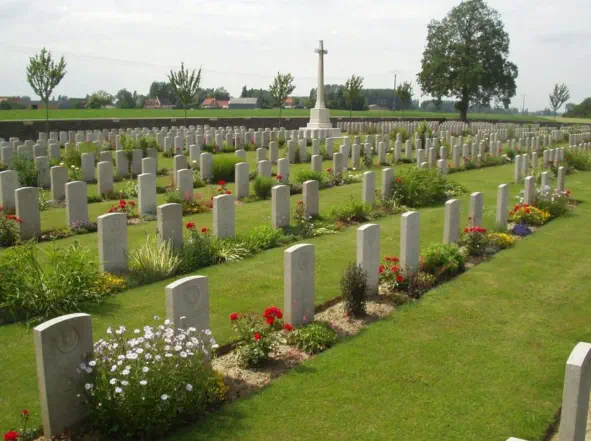
Ration Farm
Military Cem
etery at La Chapelle
– D’Arme
ntieres.
History
informa
tion
For much of the war
, Ration Farm was just over 1 kilometre behind the front line at the end
of a communication trench.
The first
cemetery
, Ration Farm Old Military Cemetery
, was
begun in Febru
ary 1915, close besid
e the far
m buildings. It was used until October 1915
chiefly by units of the 6th Division and at the
Armistice it contained 73 graves. In
April
1923, these graves were moved into Plot VI of the present cemetery
, at the request of the
French authorities.
The pres
ent cemetery was begun (
as Ration Farm New Military Cemetery) in October
1915 and remain
ed in use until October
1918. It was very gre
atly inc
reased after the
Armistice when graves
were bro
ught in fro
m i
solated sites and small cemeteries on the
batt
lefield, including:
-
CHAPEL
F
ARM CEMETERY
, FLEURBAIX, which was 2 kms West of Bois Grenier
. It
contai
ned 11 British gr
aves of 1915 and 1916.
FERME-DU-BIEZ MILIT
AR
Y
CEMETER
Y
, La Chapelle D'Armentieres, which was 2 km
s
South East of that village. It contained
36
British graves
of 1915
and
1918.
For the most part, Plots I to V contain the original burials.
Among the isolated graves
brought in were many of
Australian soldiers who died in the
Attack at Fromelles on 19 July
1916
.
There are now 1,313 Commonwealth servicemen of the First W
orld W
ar buried or
commemorated in the cemetery
. 677 of the burials are unidentified, but there are special
memorials to six casualties know or
believed to be buried among them.