
Reco
rds
show
that
Fred
Huffadine
was
born
i
n
189
3
a
t
Sutton
Hill
nea
r
to
Shifn
a
l
in
Shropshire
to
Henry
and
Sarah.
His
family
moved
to
Bromstead
when
h
e
was
four
years
old
and
later
to
Mor
eton.
Having
received
a
basic
education,
h
e
left
Moreton
School
an
d
began work
a
s
a
n agricultural labourer
.
Fred
joined
the
British
army
in
1915,
enlisting
into
the
Royal
Nor
folk
Regiment,
h
e
was
posted
to
the
1
s
t
B
attalion
wh
en
his
training
w
as
compl
eted
and
went
to
Franc
e
an
d
t
he
war
in 19
16
Fre
d’s
battalion
was
part
of
15
t
h
Brigade
o
f
5
th
Division
and
on
14
t
h
August
1
918
the
5
t
h
Division
was
withdrawn
for
rest
and
placed
i
n
GHQ
Reserve.
Two
weeks
later
it
entered
int
o
the
“Hundr
ed
Days
Offensive”.
Fighting
thro
u
gh
Albert,
to
Irles,
Beugny,
Havrincourt,
Gonnelieu
an
d
the
River
Selle,
an
d
finally
into
V
alenciennes
and
the
River
S
ambre,
the
division was in more
o
r
less continuous ac
tion until late Oct
ober 1918.
Fred
Huffadine
was
killed
i
n
action
o
n
23
rd
October
1918;
h
e
ha
s
n
o
known
grave
but
i
s
rem
em
bered
o
n
th
e
V
is
–
En
–
Artois
Memorial
between
Arras
and
Cambrai.
His
older
brother Ernest was killed in action
o
n 24
th
August 1916.
In
the
spring
of
1915
F
red, strangely
for
this
one
official
record he
is
Fr
ede
rick,
had
married
Frances
J
ohn
s
on
a
t
Edgmond,
Newport,
they
ha
d
a
son
Art
hur
H
enry
born
in
1916.
Franc
es
never remarried, she died
i
n 1972, their son
Arthur died in 1999.
Fred Huffadin
e
Privat
e
30488 - 1
st
Battal
i
on Roy
al Norfolk
Regi
men
t
Ki
lled i
n
Ac
tion 23
rd
October
1918
– aged 25
Rmembere
d on t
he V
is
-en-Artois
Mem
orial
, Pas
- de-Cal
ai
s
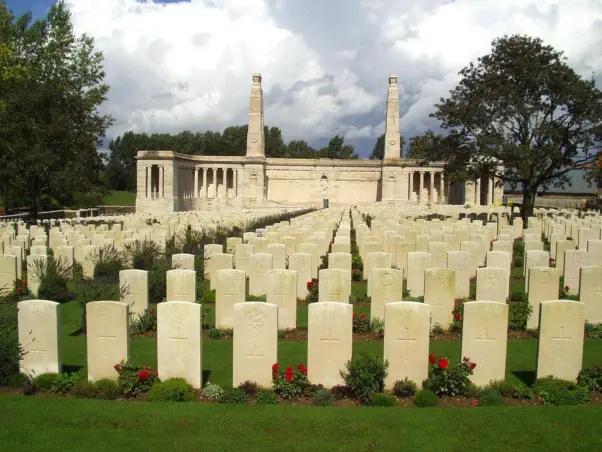
V
is-en-A
rtois M
emori
al
Historical Informatio
n
This Memorial bears the names of over 9,000 men who fell in the period from 8
August
1918 to the date of the
Armistice in the
Advance to Victory in Picardy and
Artois, between
the Somme and Loos
, and w
ho have no k
now
n grave. They belonged to the forces of
Great Britain and Ireland and South
Africa; the Canadian,
Australian and New Zealand
forces being commemorated on other memor
ials to the missing.
The Memorial consists
of a screen wall in three parts. The middle part of the screen wall is
concav
e and carries stone panels on which names
are carved. It is
26 feet high flank
ed by
pylons 70 feet high. The Stone of Remembrance stands exactly between the
pylons and
behind it, in the middle of the screen, is
a gr
oup in relief repres
enting St Georg
e and the
Dragon. T
he flanking parts of the screen wall are also c
urved and carry stone
panels
carved with names. Each of them forms the back of a roofed colonnade
; and at the far end
of each is
a small building.