
Between
1885
and
191
1
the
Huffadine
family
moved
home
several
times,
including
Brewood,
Bromst
ead
an
d
Moret
on.
Henry
Huffadine
,
k
nown
a
s
Harry
was
born
a
t
Kiddemore
Green
nea
r
to
Brewood
in
1885.
He
was
t
he
third
o
f
six
children
born
t
o
Sara
h
and
Henry
Huffadine
an
agricultural
labourer
who
became
a
traction
engine
driver
.
His
younger
brother
Fred
would
b
e
killed
i
n
action
o
n
2
3
rd
Oct
obe
r
1918
serving
with
the
1
st
Norfolk Regiment.
Harry
having
left
sc
hool
a
s
with
many
ot
her
yo
ung
st
ers
went
t
o
work
on
the
land,
in
1901
h
e
was
employed
a
s
a
carter,
but
then
perhaps
looking
for
something
better
in
his
young
life
h
e
enlisted into the British army
.
Henry
Huf
fadine,
became
a
professional
soldier;
h
e
had
first
tasted
th
e
military
life
when
in
November
1905
he
joi
ned
the
3
rd
Volunteer
Battalion
of
t
he
King’s
Shropshire
Light
Infantry
(KSLI).
The
3
rd
battalions
o
f
county
regiments
were
the
forerunners
o
f
the
T
erritorial
Army
which
came
into
being
in
1908.
Joining
the
3rd
battalion
gave
a
young
man
an
idea
o
f
what
soldiering
was
all
about
without
making
the
co
mmitme
nt
of
taking
the
King’s shilling and signing
up
for 5 years
with
th
e colours
and
7
years
o
n the Reserve
.
It
seems
that
t
he
military
life
was
to
Harry’s
liking
for
within
a
year
h
e
had
enlisted
into
t
he
KSL
I
a
s
Private
8068.
Upon
c
ompleting
his
basic
training,
he
was
posted
to
the
2
nd
Battalion
a
t
t
hat
ti
me
stationed
in
India;
h
e
became
a
cook.
He
was
later
trans
f
erred
t
o
the
1
s
t
Battalion
serving
i
n
Ireland.
With
the
outbreak
o
f
war
i
n
August
1914
his
battalion
was
mobilised
a
t
T
i
ppe
rary
an
d
arrived
in
France
o
n
1
1
th
September
.
The
1
st
KSLI
formed
part
o
f
the
16
th
Bri
gad
e
in th
e
6
t
h
Division.
On
1
st
August
1916
1/
KSL
I
along
with
other
battalions
o
f
the
16
th
Bri
gade
was
ordered
t
o
join
General
Gough’s
Reserve
Army
o
n
the
Somme.
On
15
th
August
1/KSLI
took
over
trenches opposite Beaumont
-Hamel.
On
24
th
August
1916
Harry
Huf
fadine
was
killed
in
action,
a
s
a
result
o
f
the
ever
-present
artillery
shelling
o
r
per
hap
s
the
w
ork
of
a
snip
er;
he
ha
s
no
known
grave
but
is
re
membered
o
n the Thi
epval Me
morial.
Henry Huffadine
Private 8068
5
th
B
attal
ion Ki
ng’s
Shrops
hir
e
Light
I
nfa
nt
ry Ki
l
led in
Ac
tion
24
th
Augus
t 1916
– aged 31
Remem
ber
ed on
the
Thiepv
al
Me
mori
al
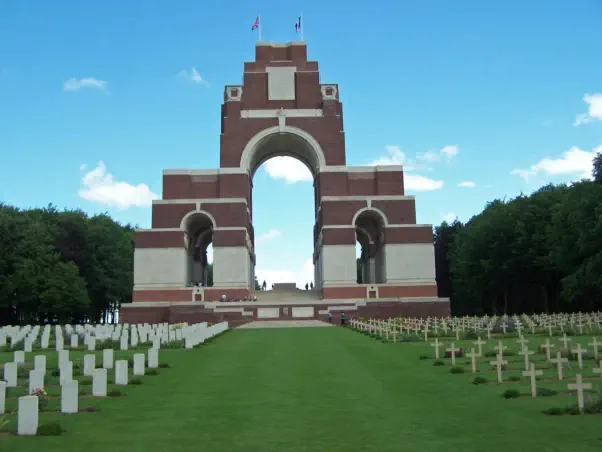
Thiepval Memorial,
Somme
Historical Informatio
n
On 1 July 1916, supported by a Frenc
h attack
to the sout
h, t
hirteen divisions of
Commonwealth forces launched an offensive on a line from north of Gommec
ourt to
Maricourt. Despite a preliminary bombardment lasting seven days, the Ger
man defences
were barely touched and the attack met unex
pectedly fierce resistance. Losses were
catastrophic and with only mini
mal advances on the southern fl
ank, the initial attack
was a
failure. In the following weeks, huge resources of manpower
and equipment w
ere
deployed in an attempt to exploit the modest successes of the first day
. However
, the
German
Army resisted tenaciously and repeated attacks and counter attacks meant a
major battle for every village, copse and farmhouse gained.
At the end of September
,
Thiepval was finally captured. The village had been an original objective of 1 July
.
Attacks
north and eas
t continued throughout October and into November in increasingly difficult
weather conditions. The Bat
tle of the Somme
finally ended on 18 November with the onset
of win
te
r
.
In the spring of 1917, the German forces fell back to their newly pre
pared
defenc
es, the
Hindenburg Line, and there were
no
furth
er significant engagements
in the Somme s
ector
until the Germans mounted their major of
fensive in March 1918.