
Frederick Henry Machin was born on 26
th
May 1889 in the tiny hamlet of L
ynn, which is
four
miles to the south of Newport, Shropshire. He was the oldes
t of the ten children born
to James Machin a
farm waggoner and his wife Sarah. A few weeks later on the 23
rd
June, Frederick was baptised at the little chapel
dedicated to St Peter at W
oodcote.
Frederick received a very basic education at the W
oodcote Estate/Church of England
Controlled Primary School. When he left sc
hool at 14 years
of age, Frederick found w
ork
at a local farm, the 191
1 census recording him as being a groom (domestic). A domestic
groom cared for the family horses, managed the stables
and cleaned the tack and
carriag
es.
When Frederick Machi
n enlisted is not k
nown, nor whether he volunt
eered
or was
conscripted; however’ on his medal card it is
recorded that he was awarded the British
W
ar Medal and V
ictory Medal. These medals were awarded for active service after the 1
st
January 191
6
.
Following his training Frederick was posted to the 2/5
th
Battalion North Staffordshire
Regiment a T
erritorial Force unit formed in Hanley
, Stoke on T
rent on 1
st
November 1914.
The battalion fought on the Wes
tern Front as
part of the 176th Brigade, 59t
h (2nd North
Midland) Division befor
e bei
ng absorb
ed into the 1/5th Battalion in
early 1918.
In September 1917, the 2/5th Battalion, North Staf
fordshire Regiment was serving in the
176th Brigade of the 59th (2nd North Midland) Division.
The battalion was heavily involved
in the
Third Battle of
Y
pres
, unof
ficially known as Passchendaele.
During the night of 23
rd
/24
th
September 1917, the 59th Division moved into the Y
pres
Salient to relieve the 55th (West Lancashire)
Division in the Gravenstafel/Polygon Wood
sector; leading up to the phase of the offensive know
n as the Battle of the Meni
n Road
Ridge and the Battle of Polygon W
ood. During this push, the 2/5th North Staffs (part of the
176th Brigade, 59th Di
vision) faced intense count
er-attacks
and shelling.
The North Staf
fords was
heavily engaged in the
fighting that took place in the northern
sector of the Y
pres Salient, moving toward the Zonnebeke and Polygon W
ood areas and
was succe
ssfu
l
.
Because the advance achieved its objectives relatively quickly
, the regiment's casualties
were comparatively light. During this specific engagement, one of
ficer
, one sergeant, one
lance corporal and six privates
were killed in action
, one of
the privates was Frederick
Henry Machin. He has no known grave but is remembered on the T
yne Cot Memorial and
at
St
Mary’s church, Moreton.
Frederick He
nry Machin
Private 2019
70 - 2
/5
th
North Staffordsh
ire Regi
men
t
Ki
lled in
Ac
ti
on
–
24
th
Septem
be
r1
917
– aged
28
Remembered on the T
yne Cot Memorial
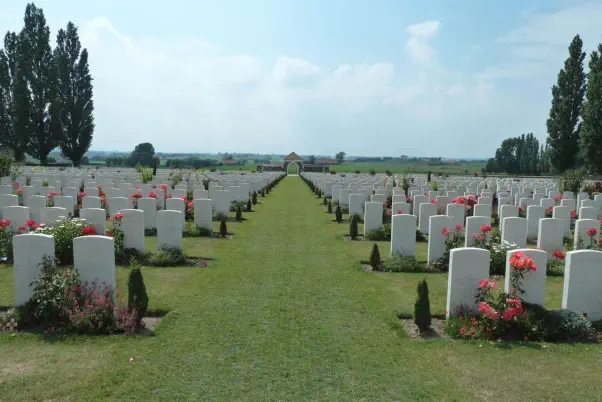
T
yne Cot Memorial, Zonnebeke
,
Historical Informatio
n
'Tyne Cot' or 'T
yne Cottage' was the name given by the Northumberland Fusiliers to a barn
which stood near the level crossing on the Passchendaele
-Broodseinde road. The barn,
which had become the centre of five or six German blockhouses, or pill
-boxes, was
captured by the 3rd
Australian Division
on 4 October 1917, in the advance on
Passchendae
le.
One of these pill-boxes
was unusually larg
e and was used as an adv
anced dressing
station after its capture
. From 6 October
to the end of March 1918, 343
graves w
ere made,
on two sides of it, by the 50th (Northumbrian) and 33rd Divisions, and by tw
o Canadian
units. The cemetery was in German hands again from 13
April to 28 September
, when it
was finally recaptured, with Passchendaele, by the Belgian
Army
.
It was greatly enlarged after the
Armistice when remains were brought in from the
battlefields of Passchendaele and Langemarck, and
from a few small burial grounds.
It is now the largest Commonwealth war cemetery in the world in terms of burials.
At the
suggestion
of King
George V, who visited the cemetery in 1922, the
Cross of Sacrifice was
placed on the original large pill-box.
There are three other pill-boxes in the cemetery
.