
Alfred
Neville
was
born
a
t
Great
Chatwell
o
n
21
April
1889
and
that
he
was
the
eig
hth
o
f
nine
children
born
t
o
Edward
and
Sarah.
I
n
1907
h
e
married
Fanny
Bickley
o
f
Penkridge
and
they
had
three
daughters
Sarah
Ellen(
1908),
Francis
Margaret
(1
910
)
an
d
Violet
Mabel
(19
1
1
).
According to the 191
1 census he was a waggoner working on a farm.
Sadly
, Fanny died in 1913 aged just 32.
With
the
comi
ng
o
f
war
i
n
1914
Alfre
d
was
one
who
answered
the
call
t
o
ar
ms
enlisting
int
o
the
North
Staffordshire
Regiment
in
November
o
f
that
year
.
It
is
surprising
that
h
e
enlisted
so
early
i
n
the
war
bearing
in
mind
that
h
e
was
a
widower
with
three
yo
ung
children
the
oldest being 6 years
old. It seems that the children went
t
o live with family
members.
Having
c
ompleted
his
military
training,
h
e
was
posted
to
the
8
th
Battalion
North
Staffordshir
e
Regiment
with
whom
he
serv
ed
in
France
an
d
Flanders.
The
1
st
July
1916
saw
th
e
beg
inning
o
f
the
Battle
o
f
the
Somme,
that
da
y
saw
the
British
army
suffer
6
0,000
casualties
including
2
0,000
dead.
Despite
the
horrific
losses
the
battle
continued,
in
fact
the
fighting
did not stop until November and the onset
o
f wint
er
.
The
8
th
North
Staffs
went
into
action
on
the
Somme
o
n
the
3
rd
July,
their
objective
the
totally
demolished
villag
e
o
f
La
Boiselle.
According
to
the
of
ficial
history
th
ere
was
a
lot
o
f
confusion
within
the
village
when
the
Staffords
reached
it
and
a
c
oun
ter
-attack
b
y
the
Germans
succeeded
i
n
pushing
them
back.
The
line
was
stiffened
b
y
the
arrival
o
f
two
companies
from
the
Royal
Warwickshire
Regiment
which
drove
th
e
Germans
back.
The
position was then held until they were reliev
ed
the
following
morning.
His
service
records
confirm
that
following
this
battle
amongst
the
missing
was
Alfred
Neville
an
d
that
in
the
c
hao
s
o
f
war
it
was
no
t
confirmed
until
10
th
February
191
7
that
h
e
ha
d
died
o
f his wo
und
s
and had been buried.
Sad
ly
however
,
his
grave
was
lost,
most
likely
destroyed
b
y
artillery
fire
and
h
e
now
i
s
recorded
a
s
having
n
o
known
grave
but
is
one
o
f
the
72
,
00
0
rem
embered
o
n
the
Thiepval
Mem
orial.
His name is
also on the Roll of Honour in
St Mary’s Church,
Moreton
.
Alfred Neville
Private
15226 – 8
th
Battalion North
Staf
fordshi
re Re
giment
Ki
lled in
Ac
tion 9
th
J
ul
y
1916
– aged 32
Remem
ber
ed on
the
Thi
epv
al
Me
mori
al
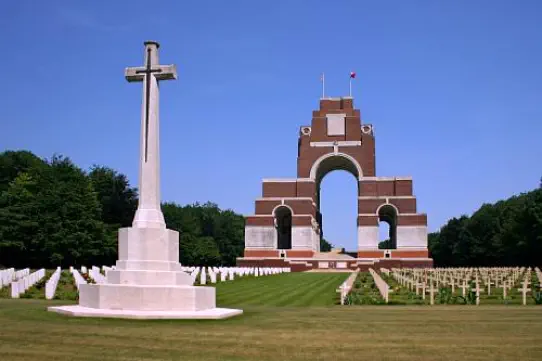
Thiep
val Mem
orial
Historical Informatio
n
On 1 July 1916, supported by a Frenc
h attack
to the sout
h, t
hirteen divisions of
Commonwealth forces launched an offensive on a line from north of Gommec
ourt to
Maricourt. Despite a preliminary bombardment lasting seven days, the Ger
man defences
were barely touched and the attack met unex
pectedly fierce resistance. Losses were
catastrophic and with only mini
mal advances on the southern fl
ank, the initial attack
was a
failure. In the following weeks, huge resources of manpower
and equipment w
ere
deployed in an attempt to exploit the modest successes of the first day
. However
, the
German
Army resisted tenaciously and repeated attacks and counter attacks meant a
major battle for every village, copse and farmhouse gained.
At the end of September
,
Thiepval was finally captured. The village had been an original objective of 1 July
.
Attacks
north and eas
t continued throughout October and into November in increasingly difficult
weather conditions. The Bat
tle of the Somme
finally ended on 18 November with the onset
of win
te
r
.
In the spring of 1917, the German forces fell back to their newly pre
pared
defenc
es, the
Hindenburg Line, and there were
no
furth
er significant engagements
in the Somme s
ector
until the Germans mounted their major of
fensive in March 1918.
The Thiepval Memorial
, the Memorial to the Missing of the Somme, bears the names of
more than 72,000 officers and men of the United Kingdom and South
African forces who
died in the Somme s
ec
tor bef
ore 20 March 1918 and
have no know
n grave. Over 90% of
those commemorated died between July and November 1916. The memorial als
o serves
as an
Anglo-French Battle Memorial in recognition of the joint nature of the 1916 offensive
and a small cemetery
contai
ning equal numbers of Commonw
ealth
and Fre
nch graves lies
at the foot of the
me
morial.