
Richard
Scott
was
baptised
a
t
St
Mary’s
Church,
Moreton,
Staffordshire
on
12
th
September
1886.
He
was
the
fifth
child
born
to
local
bricklayer
Richard
Scott
and
his
wife
Jane
Lovatt. His family had lived in Moreton/Bromstead since
a
t least 1777
.
Ric
hard having received a
ba
si
c educati
on at
Moreto
n village school f
ol
lowe
d
in his
fa
ther’s footsteps by becoming an apprentice bricklayer
.
The
191
1
census
records
that
Richard,
no
w
2
6
years
old
is
a
bricklayer
and
a
single
m
an
living
with
his
parents
a
t
Moreto
n.
In
1913
he
m
arried
Rose
W
eaver
a
t
Madeley
i
n
Shropshire
and
returned
to
live
Moreton
(Rose
later
moved
to
Lon
gno
r
,
Buxton).
They
d
o
no
t seem
t
o have had children
.
In Stafford, on the 1
1
th
December 1915, Richard enlisted with the Royal Engineers as
Sapper 177046 when he was 29 years and
8 months
old. F
ollowing
a medical
examinati
on
(weighing in at 160 lbs.), he was transf
erred to Hunts
Fortress (work
s) Royal Engi
neers
(3120) where his bricklayin
g wa
s described
as ‘superior’
and
became
Sapper 521902 with
o/c 508
th
(Wessex) Reserve Field Co. Royal Engineers.
At his second medical (in Lichfield
on the 1
st
June 1916)
he was described as
weighing 146 lbs.
, being 5 foot 8 ½ inches tall
with good physical development and excellent vision. Richard was in training until the 26
th
May 1917 and embarked for France with the British Expeditionary Force the following day
.
Just over two months later he was dead; having been injured twice (on the 25
th
June and
the 8
th
July) and by then with 419 Coy
. Royal Engineers.
Richard
Scott
was
killed
in
acti
on
o
n
31
st
July
1917.
This
day
saw
the
beg
in
ning
o
f
the
T
hird
Battle
o
f
Ypres,
better
known
to
history
a
s
Passchen
dae
le.
During
the
afternoon
rain
fell
o
n
the
battl
efield
an
d
over
the
succeeding
days
the
shell
torn
ground
w
as
turned
i
nto
a
quagmire.
The
fighting
a
t
Pilkem
Ridg
e
lasted
three
days
and
ended
o
n
2
nd
August,
British
an
d
French
forces
lost
2
7,000
casualties
dead,
wounded
and
missing.
Many
o
f
the
dead,
including
Richard
Sc
ott
have
n
o
k
nown
grave
and
are
remembered
o
n
the
Menin
Gate
a
t
Y
pres in Belguim
.
Richard Scott
Sapper 521902 – 419
th
Field Comp
any Royal Engineers
Ki
lled in
Ac
tion 31
st
J
ul
y
1917
– aged 31
Remem
ber
ed on
the Me
ni
n G
ate
at
Y
p
res in Be
l
gu
i
m
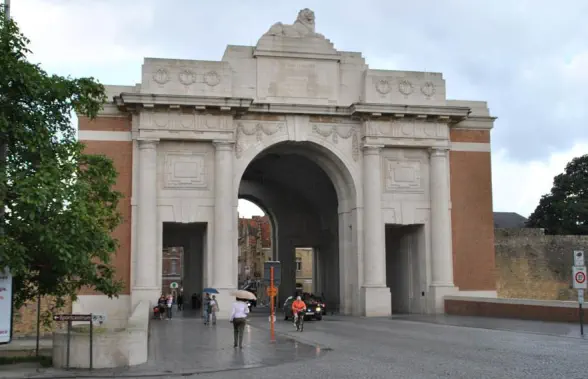
Y
pres (Menin Gate) Mem
orial
Historical Informatio
n
Y
pres (now Ieper) is a town in the Province of W
est Flanders. The Memorial is situated at
the east
ern side of the
town on the road to Menin (Menen) and Court
rai (Kortrijk).
Each night at 8 pm the traf
fic is stopped at the Menin Gate while members of the local Fire
Brigade sound the
Las
t Post
in the roadway under t
he Me
morial's
arches.
The Meni
n Gate is one of four memorials to the missing in Belgian Flanders which cover
the area known as the Y
pres Salient. Broadly speaking, the Salient stretched from
Langemarck in the nort
h to the nort
hern edge in Ploegsteert Wood in the sout
h, but it
varied in area and shape throughout the war
.
The Salient was formed during the First Battle of Y
pres in October and November 1914,
when a small British Expeditionary Force suc
ceeded in s
ecuring the town bef
ore the onset
of winter
, pushing the German forces back to the Passchendaele Ridge. The Second
Battle of Y
pres began in
April 1915 when the Germans released poison gas into the
Allied
lines north of Y
pres. This was the first time gas had been used by either side and the
violence of the attack forced an
Allied withdrawal and a shortening of the line
of defence.
The site of the M
enin Gate w
as chosen bec
ause of the hundr
eds of thous
ands
of
men who
passed thro
ugh it on their way to the battlefiel
ds. It commemorates
casualties
from the
forces of
Australia, Canada, India, South
Africa and United Kingdom who died in th
e
Salient. In the case of United Kingdom casualties, only those prior 16
August 1917 (with
some exceptions). United Kingdom and New Zealand servicemen who di
ed after t
hat date
are named on the memorial at
T
yne Cot, a site which marks the furthest point rea
ched by
Commonwealth forces in Belgium until nearly the end of the war
. New Zealand casualties
that died prior to 16
August 1917 are commemorated on memorials at Buttes New British
Cemetery and Messines Ridge British Cemetery
.