Joseph was the son of Benjamin &
Ann
T
aylor
. He was born in 1883 at Church Eaton.
In 1891 he was living at Goosemore,
Gnosall with his brother Benjamin and widowed
fa
ther
.
In 1901 he was a serv
ant (A
gricultural Labourer), living at Bro
okfield
House, Haghton.
The 191
1 Census shows him living at
Audmore Cottage,
Audmore, working as an
Agricultural Labourer
, living with presumable relatives William & Mary
T
aylor
.
Without any certainty
, we believe Joseph’s army record
is Service Num
ber 241471, a
Private in the 2/6th (T
.F
.) Battalion, South Staf
fordshire Regiment
, having signed up at
T
ipto
n, Staf
fs
.
If so, he died 30
th
November 1917
and is commemorated
on Cambrai Memorial,
Louv
erval, France, Panel 7.
Joseph T
a
ylor
Private 241471 - the 2/6
th
(T
.F
.) Battalion, South Staffordshire Regiment
Died 30
th
Nov
em
ber 1917
– age 34
Commemor
ated
on
Cambr
ai
Mem
orial
, Lou
v
erv
al
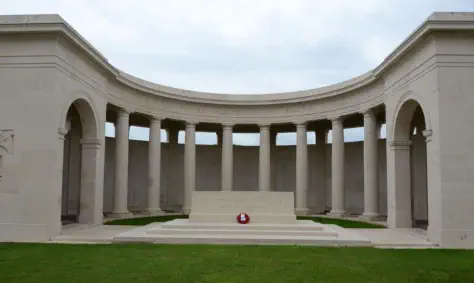
Cam
brai Memorial, Louverval
History
informa
tion
The CAMBRAI MEMORIAL
commemorates more than 7,000 servicemen of the United
Kingdom and South
Africa who died in the Battle of Cambrai in November and December
1917 and whose
graves are not known.
Sir Douglas Hai
g described the object of the Cambrai
oper
ations
as
the
gaining of a 'l
ocal
success by a sudden attack at a point where
the enemy di
d not ex
pect it' and to some
extent they succeeded. The proposed method of assault was new
, with no prelimina
ry
artillery bombardment. Instead, tanks would be used to break thro
ugh the Ger
man wire,
with the infantry followi
ng under
the cover
of smoke barrages.
The attack began early in the morning of 20 November
1917 and initi
al adv
ances w
ere
remarkable. However
, by 22 November
, a halt was called for rest and reorganisation,
allowing the Germans to reinforce. From 23 to 28 November
, the fighting was
concentrated almost entirely around Bourlon Wood and by 29 November
, it was clear that
the Germans were
ready for a major counter attack. During the fierce fighting of t
he
next
five days
, much of the ground gained in the initial days of the attack
was lost.
For the
Allies, the results of the battle were ultimately disappointing but valuable lessons
were learnt about new strategies and tactical
approaches
to fighti
ng. The Germans had
also discovered that their fixed lines of defence, no matter how well prepare
d, were
vulne
rable.
The Cambrai Memorial
was designed by Harold Chalton Bradshaw w
ith sculpture by
Charles S. Jagger
. It was unveiled by Lieut-General Sir Louis V
aughan on 4
August 1930.
The memorial stands on a terrace at one end of LOUVERV
AL
MILIT
AR
Y
CEMETER
Y
.
The chateau at Louverval, was taken by the 56th
Australian Infantry Battalion at dawn on 2
April 1917. The hamlet stayed in
Allied hands until the 51st (Highland) Division was driv
en
from it on 21 Marc
h 1918 during the great German adv
ance,
and it was retaken in
the
fo
llowing September
.
Parts of Rows B and C of the cemetery were made between
April and December 1917 and
in 1927, graves were brought in from Louverval Chateau Cemetery
, which had been
begun by Ger
man troops in March 1918 and used by Commonwealth forces in September
and
October 1918.
The cemetery now contains 124 First W
orld W
ar burials.